Thursday, March 12, 2009
Tuesday, January 6, 2009
New Year - New Photos


Monday, December 15, 2008
To Here...
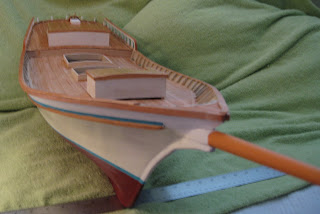
Was a long way.You can still see the planks that formed the shell under the coating of sanding primer. These photos were taken as the hull really began to take shape, all the complex curves beginning to show up.
"The planks are only 1/16" thick and vary from 1/4" to 1/2" in width. I had to be extremely careful that they were fitted as closely as possible, because I couldn't sand them down very much - they're so thin. These planks are basswood. No balsa was used anywhere." RT
The boat is 40" long and 12" wide based on a scale of 3/8" = 1 foot. At this stage, it was sanded to 'true it up' . Since this photo, 9 coats of primer (with light sanding after each coat) have been applied.
Here it is after the waterline was cut in.
(The boat plans on the wall in the background here, are for another boat - a REAL boat, if you will, which the captain has designed.)

Sunday, December 14, 2008
In these photo, taken December 2, from the stern, you can see some of the detail work.

Every piece on this ship is hand-fashioned, carved from wood and ivory, with the exception of a few metal pieces which are worked by hand as well. The facing for the rails is steam-bent oak, as are ribs of the boat. The decking is made of oak planking 3/32 x 1/4".
The steering station: The wheel is all done by hand, of red oak , with the spokes painstakingly carved and fitted. In the center, the hub is made of walrus ivory.


In the Beginning...


The photo below, shows the schooner 'Belle which is a vintage example of the design.
"The hull of the Belle is similar and a good representation of the type of vessel. The sail arrangement, however, is different. Because of the nice shape and design, many replicas of these ships are still in use on the East Coast of the U.S. as passenger and pleasure vessels." R.T.

The Schooner "Belle"
These ships often had women's names. Many had the full name, such as the 'Bessie Boalt' and the 'Emily Cooper'. Others were named after certain attributes, like the 'Active' and the 'Pathfinder'. One was called the 'Home' and one, the 'Experiment'!
"These boats were beautiful, working very hard, they played a vital role in establishing and supporting communities along the coast. They carried cargo like oyster shells, gravel, timber, and seafood, up and down the East coast of the U.S. There were many casualties, mostly because they were at the mercy of the weather, powered by sail only.
Heavy fog, no electronics, just a simple compass and a line with a weight (called a lead line) for checking the depth of the water. The weight was equipped with a hollow on the end, filled with grease, or tallow, to check the consistency of the sea-bottom - whether it was sandy, muddy, gravel, etc. The tallow would pick up a sample of the bottom and this would give the captain important information.
This line would be thrown ahead of the boat by a man in the bow, then pulled back in. The man would shout to the captain the marks on the line. All this was done while underway. Try that in a howling gale!"RT