What We Are About
This blog was started as a way to chronicle the construction of the sailboat fashioned after the North American Merchant Schooner of the late 19th Century as built by Captain Ron. The computer work is done by Nancy, but anything the captain says appears in quotes (possibly edited, but maybe not!) So this is a joint effort by the two of us. The log was started long after the boat was started, although we had continued taking photos from the very beginning. We'll be backtracking to the early stages of construction. Hope you enjoy seeing this project come together.
To view the complete construction log, click on the "2008" on the right sidebar. That will take you to the very first posts.
This ship is listed for sale, now and we just took some final photos for the advertising.
Here are a few of the final photos.

There have been many tiny details added, like cleats and things.
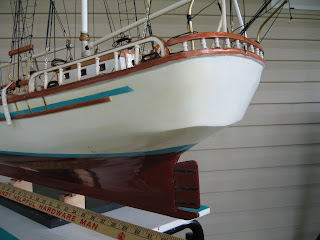
The hull has been polished and lacquered sooo many times. It just glows.
Some of the chain was replaced with rope.

I love those beautiful compound curves.

The bowsprit has been tapered more than it was originally.


I think I want to live aboard!

Looks pretty cozy to me.

I'm gonna miss her.

Taken on July 13, 2009. Notice all the tiny details that have been added since the last photo op.


She's nearly done. This sailing ship is hand-fashioned after the North American Merchant Schooner of the late 1800's. These ships were used for carrying goods along the East Coast of the United States. and South America.
I recommend you click on the photos to enlarge the detail.

Showing the masts and yardarms.

It looks so real!

The bowsprit is inlaid with ivory diamond shapes and a star on the very front.

Lowering the skiff.

A view of the midships, looking forward. This shows off some of the curves in the boat design. The hatch coamings are raised to support the hatch covers which give access to the interior holds. Note the oak planking of the deck.

Aerial view of the stern shows the lifeboat, suspended from its davits. The davits are fashioned of brass with miniature pulleys that raise and lower the boat. Notice the life ring and fire axe atop the house.

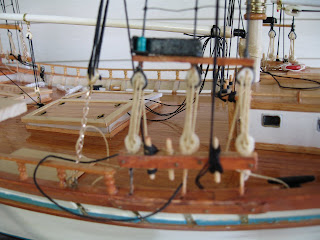
All the rope work is hand-tied. The ivory rope blocks in the foreground are used to tighten the mast stays. They are authentic miniatures and absolutely work.

In the foreground, at the rail you can see cleats and rope chocks, carved by hand and painted black. There are a total of 12 cleats on the boat and 8 chocks.

This shows a portion of the living quarters below the removable house. See the barrel on the deck? The cooper is not finished with it yet.

Below decks you can see the step of the mast and the inside framing. Note the anchor winch (it really weighs the anchor and is turned by hand.)

See how the mast and bowsprit line up with the keel. She's true, and straight as an arrow.

Elegant shape.
New photos, and these will be some of the last ones before it's finished. The boat will go up for sale in the near future. It represents some 6 months of steady work. Remember, all the parts and pieces are made by hand and, with the exception of things like, say, the bell, all is hand-fashioned. Look closely at the blocks and tiny fittings. Some are made of ivory, but all are handmade and really work. Ropes and pulleys, rudder and steering wheel, doors, etc. are all functional.
Captain Ron is listed with the Department of the Interior - Indian Arts and Crafts Board. A member of the Alutiq Tribe of the Koniag Island Group (Kodiak) of Alaska.
Please direct any inquiries to:
These shots were taken in February, about a month ago.
It's very lightweight (no ballast... yet!)


It floats right where it should and will have proper trim when it's ready to sail.

We'll be back now, with more photos and updates. The ship is acquiring detail work
I never dreamed of. The captain is doing the most fantastic work. --Nancy


Here is how she looks today.
See how the little rope ladders are coming along. With needle and thread!


These little blocks are hand carved from Walrus ivory and really work. The life rings are carved out of oak, painted and the line added.
Gotta have a fire axe. It will be mounted.
In answer to Diane's previous question, yes. Everything will be watertight. Just like a real one.
Let me take this opportunity to apologize to those of you without blogging accounts who were unable to comment. There was one little setting I missed. Everyone should be able to comment now. And we hope you do!
Thanks so much to those of you who have chosen to follow this blog. We're having so much fun, it's nice to be able to share it with you. Thanks for your kind comments. If you have questions, the captain will be glad to answer them. I'm trying to get him to talk about what he's doing so I can put in as many quotes as possible! --Nancy
From Here...

To Here...

Was a long way.
You can still see the planks that formed the shell under the coating of sanding primer. These photos were taken as the hull really began to take shape, all the complex curves beginning to show up.
"The planks are only 1/16" thick and vary from 1/4" to 1/2" in width. I had to be extremely careful that they were fitted as closely as possible, because I couldn't sand them down very much - they're so thin. These planks are
basswood. No balsa was used anywhere." RT

The boat is 40" long and 12" wide based on a scale of 3/8" = 1 foot. At this stage, it was sanded to 'true it up' . Since this photo, 9 coats of primer (with light sanding after each coat) have been applied.

Here it is after the waterline was cut in.
(The boat plans on the wall in the background here, are for another boat - a REAL boat, if you will, which the captain has designed.)

You can see how smooth the finish came out in this photo of the bow.